Example: Assignment 1: Research Questions – athenaaegis

NOTE:  athenaaegis is my blog name for this class.

FOR THIS ASSIGNMENT, ASSUME THAT YOU WILL NEED MOSTLY SCHOLARLY ARTICLESA COUPLE OF POPULAR ARTICLES ARE ALLOWED.  

1. Topic:  I’m interested in researching Galla Placidia.

NOTE: you are not required to explain your topic;  however, I think your fellow students might find lengthier explanations interesting.  Galla Placidia had a very interesting life.  She was the daughter of Theodosius the Great, who was the last Roman emperor to rule a united empire.   She was taken hostage by the Visigoths and then married their king, Ataulf.  At his death, she was returned to her brother, Honorius, then Emperor of the Western Empire, and was married to one of his supporters, with whom she had two children.   When the second husband died, she fled to Constantinople and her nephew, Theodosius II, emperor or the eastern Roman empire, because her brother was “too fond” of her.  When Honorius died, Galla Placidia’s son, Valentinian III, received the title of Emperor of the West in his place and the family moved back to Italy.  Since Valentinian was a minor, Galla Placidia ruled the western Roman Empire for about 12 years as his regent (definition).  She continued to have  significant political influence until she died.

Shortly before Galla Placidia’s death in November of 450 CE,  her  daughter, Honoria, inadvertently saved Constantinople by aiming  Attila the Hun at Italy.  Honoria wrote Attila a letter asking him to get her out of a marriage she didn’t want.  She included her engagement ring in the letter.  Attila came to claim her and suggested that half of the western empire would make a good dowry.  Honoria was quickly married off to a senator and Valentinian disavowed the legitimacy of the offer.  Attila proceeded to ravage Italy anyway, using the letter as an excuse.  These actions did not endear Honoria to her brother, the emperor, and she only escaped execution due to her mother’s intercession.  Honoria disappears from the record a few years later.  Some scholars believe that Valentinian III had her executed  after their mother’s death.  (Want to know more about Galla Placidia?  The Wikipedia article is a good place to begin.)

2.  Core question:  What does Galla Placidia’s life tell us about the role of imperial women in the later Roman Empire?

Remember, your core question should be related to your topic, but be much more focused than the topic.

Why I’m interested in this aspect of the topic

I’m interested in this aspect of the topic because Galla Placidia was a part of many of the important events that took place during the twilight of the western empire.  She also exercised political power to a degree that was unusual  even for the daughter, sister, aunt, and mother of emperors.   If her son by the King of the Visigoths hadn’t died,  she and her husband might have founded a Romano-barbarian dynasty that perhaps could have prevented the fall of the western empire.  As it was, she ruled the Western Roman Empire for over ten yea

Your explanation should be related in some way to your core question.  Don’t tell me that you love Roman history, tell me why you’re interested in the assassination of Julius Caesar or the sewer system of the Indus Valley civilization (much more interesting than you might suspect), etc.

3.  Research Question:  I could use my core question, but more formal, academic language would be better since I need to find scholarly articles.

`How was Galla Placidia a role model for imperial women in the Later Roman Empire?

You will be able to tweak your topic as you begin researching, but you cannot make significant changes without my approval.  Not sure if a change is significant or not?  Convo me.

Keywords and key phrases:  “Galla Placidia”  “imperial women”  “role model”  life  “Later Roman Empire”

Pick your main keywords and key phrases directly from your research question.   

EXCEPTION:  if there is more than one way to say the same thing.  This usually applies to science, technology, health and some social science fields as opposed to history and the arts & humanities, but is possible for those fields as well.   For example, you could call the 1890s part of the Victorian era, the Progressive era or the Gilded Age, etc. depending on your specific topic.

Alternative keywords/phrases:  “royal women”  “Late Antiquity”  biography, “Byzantine Empire”

“Late Antiquity”  is broader than “Later Roman Empire,”  so you would use it only if “Later Roman Empire” was not finding the sources you needed.  “Byzantine Empire” is more specific than “Later Roman Empire.”  Byzantine is the name we use; the people who lived there called it the Roman Empire of the East.  Most of the imperial women come from the Byzantine, or Eastern, Empire, so it might be a useful term.

Always start with the keywords and phrases that are part of your research question.  You can add others as you need to.  If you find yourself needing to add a lot of other keywords/phrases, then you probably need to rewrite the research question.


Leave a comment

Filed under Uncategorized

Information types & formats 1: sources classified by audience

Why do you need to learn about types and formats of information?  Well, for one, it’s one of the learning outcomes for this class.  More importantly,  the inability to find and use the right kinds of sources is one of the major roadblocks between students and good grades on history papers.  Finally, the more you know about finding the right kinds of sources, the easier it is to find and identify them.

This reading introduces the main types and formats of information in all fields, including history.  As you’ll discover later in the reading,  history sources are not as easy to distinguish as those in other fields.  Future readings will look at more specific types of sources.

Information Formats

Let’s start with the easy part:  formats.  The word format has a number of meanings; for this post, we’re looking at the format or makeup or composition of something.  The most common formats you’ll deal with doing academic research are print and online; however, there are others such as  CDs, DVDs, streaming music & videos, and microforms.

Most instructors accept a variety of formats as long as you choose relevant sources of the correct information type.

Information Types

There are three basic ways to divide information types for academic purposes.  These are:

  1. sources classified by audience
  2. sources classified by closeness
  3. sources classified by quality measure

These classifications refer to non-fiction (with a few rare exceptions.)

Sources classified by audience

The three main types of sources classified by audience are:

  1. popular
  2. scholarly (also known as peer reviewed or refereed)
  3. trade

Popular sources are those that are created for the general public.  They may be any format:  print, online, DVD, etc.

Popular sources:

  • are written in every day language; if there are technical or unusual terms, the terms are defined & examples given
  • are often written on broad topics or as an introduction to a topic.  Usually  written by journalists or freelance writers  or “anonymous” (usually an editor or staff writer.)
  • rarely have notes or bibliographies (reference lists).  Some will have lists that contain suggestions for further reading and/or notes that provide more information on the content
  • are often very colorful with a lot of illustrations and photos
  • are found in grocery stores, bookstores and airports in addition to libraries.  Many are also available on the web.
  • may be print or online books, magazines, and newspapers, or general websites.

Examples: 


Scholarly sources are those that are created for experts and for students studying the subject area.  They may be any format:  print, online, DVDs etc.

Scholarly sources:

  • are written by experts in the field
  • are written for an audience of other experts (and students who have to learn the information)
  • are usually peer reviewed or refereed
    • this means they been judged by a panel of fellow experts and found worthy of publication
  • have notes and a reference list or bibliography
    • in some history and arts and humanities sources, there is no bibliography or reference list.  All the necessary information is given in footnotes.
  • are often published by, or in conjunction with,  universities, museums or other institutions
    • they may also be published by specialty academic publishers such as Oxford, Wiley or Elsevier
  • most common types are: journal articles and books, either print or online
  • there are also a few scholarly websites

 All scholarly sources have the things listed above in common.  However,  there are differences between scholarly sources in the sciences, technology & engineering, social science and professional fields and scholarly sources in history and the arts & humanities.

Scholarly sources in the science, technical, social science and professional fields (health, business, etc.)

  • Report on experiments, studies or research performed by the authors
  • Are usually written about a very narrow, focused topic
    • literature reviews are an exception:  they review previous research on a topic
  • Use technical language with a lot of specialized words

Scholarly sources in history and the arts & humanities

  • are written about original research on an historical, literary, artistic or performance topic
  • are usually focused, but occasionally cover broad topics
  • rarely use technical language; instead, they use formal, academic language

Examples


Trade sources are written for practitioners in a field.  They focus more on “how-to” information.  They may be any format.

Trade sources:

  • contain practical, how-to information as well as information about the field, such as best practices, finding a job, rules and regulations, etc.
  • may have some scholarly research articles, but focus is practical
  • use language and terms specific to that field 
  • are often produced by professional associations or publishers who specialize in the field

NOTE:  the line between scholarly, popular and trade can be hard to determine.  In some fields, such as health science, education and criminal justice, an instructor may allow you to use a well- researched trade article in place of a scholarly article – ASK FIRST!

Examples:


Other types of sources classified by audience

  • Textbooks
    • are usually in a category by themselves
    • are closest to trade, since they are teaching students about a field
    • as a rule, you should not use textbooks as a source for academic research
  • Newsletters
    • news about a subject or profession
    • can be very general: for example, news about science
    • can be very specific: for example, news for passenger airline pilots
    • always popular or trade, never scholarly
  • Reviews

    • opinion pieces about books, movies, music, plays, etc.

    • can be found in scholarly, popular or trade publications in print and on the web
    • b

      ook reviews in scholarly journals are NOT scholarly

    • Use reviews for background information, do NOT use them for academic research

      • Exception: people researching performing arts productions often use reviews of productions

  • Editorials, opinion pieces, letters

    • o

      pinions by different people on a variety of subjects

    • c

      an be found in scholarly, popular or trade publications in print and on the web

    • c

      an be used as examples in academic research – not as articles

    • t

      hey are popular or trade even if they appear in a scholarly publication

Leave a comment

Filed under Information Types & Formats

Primary Sources

Primary sources in most subject areas  are nice and straightforward.  You do a study or run an experiment then you write an article or sometimes a book.  An article or book based on research that the author or authors did is a primary source in the sciences, health sciences, sociology & psychology, and professional fields such as education and business.

Things are a bit more complicated in history, in large part because the definition of primary source is a bit of a moving target. For example, sources accepted as primary in ancient history are not acceptable in more modern historical fields.   Despite the difficulty of determining what is and isn’t a primary source, it’s absolutely necessary that you start learning to recognize them when you see them because primary sources are the basic building blocks of scholarly research.  In this reading, we’ll look at primary sources for the ancient world and how to find them;  we’ll also look at finding primary sources for more recent periods of history.

A quick review:

In the reading on Information Types and Formats, we’ll look at three important categories of information:

  • Sources classified by audience (scholarly, popular & trade)
  • Sources classified by closeness (primary and secondary)
  • Sources classified by quality measure.
The reading on Information Types and Formats defines primary sources as those that are closest to an original event, an  original time period, original research or an original idea.

 Common primary sources for history include:

  • Journals, diaries, letters
  • Speeches
  • Interviews/oral histories
  • Memoirs/autobiographies
  • Statistics
  • Inscriptions

Primary sources may also include:

  • Photographs & video recordings in various formats (including YouTube)
  • Audio recordings in various formats
  • Objects or artifacts:  art, tools, clothing, roads, buildings, houses, pottery, books & manuscripts
  • Some government publications

In some cases, you can use sources such as Twitter or newspapers or blogs as well as other  popular sources like magazines as evidence for what people were talking/thinking/reading about during the time in question.

  • Newspapers
  • Magazines
  • Advertisements
  • Maps
  • Twitter
  • Blogs
  • Facebook
  • Fiction

Primary sources in ancient history

Historians studying medieval through modern periods often wonder at material considered primary sources by ancient historians.  This has to do with the survival (or not) of the sources.

Example:  Herodotus, often called the father of history, wrote a work called The Histories in which he looked at the roots of the Greco-Persian wars.  Herodotus was born about the time the wars were ending (c. 480 BCE).   The Histories are considered a primary source because he did interviews and talked with people who were there.  Most of The Histories has survived.  However, while there are fragments that date to the 1st century C.E., the earliest extant (= surviving), mostly complete, manuscript is from the 10th century C.E.  This is true of most Greek sources.  The major exception is the New Testament:  there are almost complete manuscripts dating to about the late fourth to early 5th century with fragments dating back to the 1st century C.E.  So, even though Herodotus used  primary sources to write his Histories, it’s certainly possible people added or subtracted information in the 1,400 years or so between his death and the oldest surviving manuscript.

NOTE:  a manuscript is any document that is handwritten as opposed to printed.

Because Latin was used by the western church, the manuscript copies of  primary sources for Roman history are often several hundred years earlier than sources in Greek.   Greek was used by the eastern church, but many earlier manuscripts were lost as the Byzantine Empire crumbled.  A number of important authors, such as Aristotle, were transmitted to the West by the Islamic Caliphate and its successor states.   In the past 25 years or so, some manuscripts have come to light in areas previously part of the Soviet bloc and in areas in the Mideast, such as the Monastery of St. Catherine’s in the Sinai. (Check out the very old Greek  New Testament that was discovered there:  http://www.codexsinaiticus.org/en/).

A second issue is that often the best source is a later source.  Many scholars consider Arrian the best source for information on Alexander the Great even though he wrote more than 400 years after Alexander’s death in 323 BCE.  Why is Arrian considered the best source?  The main reason is that we know Arrian had access to primary sources, such as writings by Alexander’s generals, that  didn’t survive.  The other reason is that Arrian had experience fighting as an officer in the Roman army.  The theory is that he would therefore have had  a better understanding of Alexander’s strategy  and tactics than writers who lacked his experience.  The oldest surviving text of Arrian’s work on Alexander, which was written in Greek,  dates to about the 11th century C.E.

Are there any “truly” primary sources in ancient history?  Yes.  If you mean written sources, there are numerous inscriptions.    The Assyrians left libraries full of baked clay tablets filled with cuneiform writing.  In Egypt, papyri survive from the time of the pharaohs through the time of the Roman Empire and later.  The Egyptian Pharaohs and nobles prepared tombs whose decoration often included inscriptions.  Many ancient civilizations left inscriptions and art done in stone.  We even have the ostraka (pot sherds)  the Athenians used when they voted to exile the famous admiral Themistocles, son of Neocles.  We get our word ostracize from this practice.  These are all primary sources in the strictest sense.
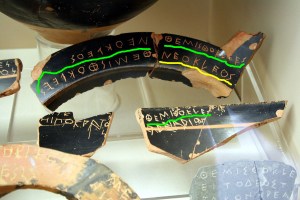
Ostraka used to exile Themistocles

By Giovanni Dall’Orto. (Own work), via Wikimedia Commons

Artifacts are important primary sources.  They’re especially important for groups like the Celts who didn’t leave much of a written record.  Artifacts can be tomb paintings, road systems, pottery, jewelry, clay tablets (the tablet itself, not just the writing), wall paintings, legionary campsites, buried cities like Pompeii and much more.

Primary sources in medieval to modern history

The closer you get to our times , the greater the number and variety of primary sources.   The internet has made it much, much easier to find and use primary sources, but you need to carefully evaluate primary sources found on the web to make sure the quality is acceptable.  You also need to know what, if any changes have been made to the sources.  Finally, for objects, you are looking at a two dimensional rendering of a three dimensional object.


Finding primary sources

Ancient History

You can use many of the methods listed below to find sources.  However, the easiest way to begin looking for primary sources in ancient history is to use an encyclopedia. If you just need one or two examples, Wikipedia is fine.  However, if you need more sources or you have been told not to use Wikipedia, check out one of our specialty encyclopedias, such as the Encyclopedia of Ancient History.  The library has access to  encyclopedias and other sources in most fields, online and in print.  To find the eresources,    go to  the library’s home page:  http://library.weber.edu.  Click on the  Article Databases icon (blue pancakes).  Click on  Subjects, then click on Reference.  Credo, The Cambridge Companions Online, and the Oxford Reference Online are all good general sources.  Credo  has basic sources in most fields.

Medieval to Modern History

Find government documents

Government documents are an excellent source of information from the Middle Ages on.  (They can also be useful in some ancient societies as well.)  While this discussion refers to the West, they also survive in the Middle East and Asia.  The further back you go, the more difficult they can be to find and access.  They also tend to be in Latin and other languages most students need to have translated.  You can find some links to translated sources in Wikipedia, but books on the topic are often a better choice for the best translations.

For U.S. government publications, check out the research guide at:   http://libguides.weber.edu/government.  You can also try a search engine.  Use regular Google, Bing, etc.

NOTE:  as a general rule, use Google, Bing and other general search engines to find primary sources for history.  Use Google Scholar to find  published articles and books that are primary sources.


Search for named sources

Use a search engine such as GoogleBing, Yahoo and DuckDuckGo.  This approach works best for specific documents with easy to search titles:

  • US Constitution
  • Universal Declaration of Human Rights
  • Treaty of Versailles
  • Kyoto Protocol
  • Constitution of Athens (Aristotle)

 Find digital collections

Do NOT pay for access to sources until you’ve double checked with your professor and your subject librarian and have made ABSOLUTELY sure there is no free access AND you don’t have time to wait for Interlibrary Loan (usually 24-48 hours, Monday – Friday.)

Most digital collections of primary sources are available for free from libraries, state and private archives and museums.  There are also a growing number  of commercial groups digitizing information.  These groups range from  newspaper and magazine publishers to database companies that provide access to specific groups of resources, such as early American magazines.

Newspapers, such as the New York Times, often provide some free content, but expect you to pay for full access.   Many newspapers now allow people to buy temporary access that includes a  number of downloads.  Some papers, such as the New York Times, have special college rates for both short term and annual subscriptions.  Database companies charge for access.  With a little bit of work, you should be able to get most primary sources for free or at least for a low cost.  Work with your professor and subject librarian to find free access. NOTE:  As of May 1, the Provost’s office will be providing access to articles (no ads, etc.) from the New York Times, from 1851 – present.  Go to:  https://nytimesineducation.com/register/  NOTE:  As of the last time I checked, you will get a Connection is not private” warning.  To continue, click on “ADVANCED”  to the left of the  blue “Back to Safety” button.  You’ll get a paragraph explaining the problem (problem with security certificate, then a link to proceed.   Click the link and follow the directions.   YOU MUST USE YOUR MAIL.WEBER.EDU EMAIL ADDRESS TO SIGN UP.

A BRIEF ASIDE ON THE VALUE OF GETTING AN UNDERGRADUATE RESEARCH GRANT – I’d like to encourage people to pursue undergraduate research grants.  History majors (and most other majors)  have had good luck getting travel money to research in archives and special collections that are not available online.  Getting a grant looks very good on your resume.  If you go to graduate school, it shows you know how to carry an academic research project to the end.  If you don’t go to graduate school, having a grant shows that you are a self starter who can plan a project and carry it out (plus, you convinced people to give you money.)  For more information, see:  http://www.weber.edu/OUR.  You can also ask me.

Looking for newspapers?   Chronicling America, from the Library of Congress, provides access to, or  information about, newspapers from 1690  through 1922.  Stewart Library has a subscription to Newspaper Archive, which covers U.S. and some international newspapers from the 18th century to the present.  Also check out the Digital Newspapers in the United States research guide.  This is an exhaustive list of digitized newspapers by state, and then county.

What’s so important about 1922/23?   You will see a lot of free publications that end in December 1922.  In the United States, material published before 1923 is no longer protected by copyright.  You still have to give credit, but you can use a large amount of information without getting permission.

WARNING:  Resources that are now in the public domain (either never or no longer protected by copyright) can have  more recent introductions, discussions, etc.  This newer information is copyrighted so you may only quote shorter amounts of the copyright portion.

Stewart Library has subscriptions to  several commercial databases that provide access to newspapers and magazines that date from the 1700s to the present day.  Go to the library’s website:  http://library.weber.edu, click on the blue pancakes icon, then click on  n News under the subject listing for newspapers.  For older magazines, go to “A” on the alphabetical listing and choose American Antiquarian Society (AAS) Historical Periodicals Collection.  JSTOR will have articles from magazines and journals dating back to 1665 (Philosophical Transactions, which was & is a science journal.  Science was then mostly called natural philosophy.) 

BACK TO FINDING DIGITAL COLLECTIONS:  Do it the easy way

The easiest way to find a digital collection is to ask someone.  Professors usually know the digital collections in their subject area.  Librarians either know of, or know how to find, digital collections in many areas.

The next easiest way to find a digital collection is to use a search engine such as Google.

You may search by  subject, location or both.

search:

digital newspaper  collections (pretty bad)

digital newspapers California (better)

digital newspapers Sacramento CA (best)

Watch out for commercial sites that charge for information that government and educational sites provide for free.  Never pay money without checking with a professor or librarian first.

To limit sites to educational, government or organizations, use a domain name limit.  A domain name is:  .edu (education), .org (organization), .gov (government), .com (commercial), .uk (United Kingdom), etc.

domain  search:

     jazz digital collections site:edu  (you could also try site:gov or site:org – you can stack domains, but I think it works best to search each separately.)

If you know a specific site has information, you’re not just sure where, you can narrow the domain search:

     Eurodocs site:byu.edu

Use OneSearch

Do a search and then limit to type of content, such as Archival Material

Use the Include results from outside your library’s collection  search to look for archival material beyond Weber State.


Find specialized local collections

You can often use a search engine to find specialized local collections available on the web – or at least find where they’re kept. Examples of local collections include the Ogden Prisoner of War  Camp collection at the WSU Library,  the Utah Ski Archive at the University of Utah Libraries, the Eurodocs collection at the BYU library and many more.

NOTE:  use Google NOT Google Scholar

For example:  a Google search on Utah diaries pulls up links to several collections – some web accessible, some available at various Utah colleges and universities.   To find the ski archives, search for Utah ski archives, and so on.

Find materials in a foreign language

Search engines such as Google, Bing, DuckDuckGo and Yahoo, work best for English language (and translated) sources.  If you want sources in a foreign language, you need to search in that language.  You should also try a search engine specific to that language, such as Google France  (https://www.google.fr)

For example:  to find letters written by Napoleon to Josephine, search:  napoleon lettres josephine.

For more political letters try Napoleon lettres relations extérieures.

Try different search engines.  They all produce slightly different results.  This is especially true if you normally use Google.  Google will try to outlets you and may discard valuable links.  Other good search engines to try are:  Bing, Yahoo and DuckDuckGo.   Be sure to try the Advanced Search features where available.

NOTE:  DuckDuckGo is useful because it doesn’t track your searches, which means it will show all results, not what it thinks you want.  If you want to stay with Google, try clearing out your search history first.


 Use a Specialty Search Engine:

Google News Archive Search – This was a very nice feature that allowed you to search old newspapers and provided aids such a timeline, etc.  The News Archive no longer exists as a separate entity; however, the content is still available if you are willing to work for it.  You can try a regular Google search. This works best if you have a specific topic (for example:  silver mining Nevada Comstock Lode).    Once you have results, click the down arrow on the right of the search box and use the advanced features, particularly the date fields.  NOTE:  Try doing a OneSearch search and limit to newspapers.  Most newspaper databases only go back to the 1990s for full text, but the articles in our Newspaper Archives database go back to at least the 18th century, and there are other exceptions.

 Google Earth  – Satellite images – requires a free software download, but gives great views of terrain.  Educational and other groups have already provided maps of important historical events such as the campaigns of Alexander the Great, U.S. Civil War battles, etc.  After you download the Google Earth software, you can either play around or download one of the programs that show battles, etc.  Look for a .kmz file.

If you’re planning on teaching, Google Earth for Educators has a lot of good information and there are some grants available from Google and other sources.

Image searching:  GoogleBing and Yahoo all have good image searches.  Also try:  Wikimedia Commons,  Google Art Project, and Flickr Creative Commons (be careful to stay on the Creative Commons part of the website.)  Finally, many museums are now allowing non-profit use of their materials.  Try to find a museum covering your time period or area or a general museum such as the New York Metropolitan Museum of Art, the Smithsonian, The British Museum and The Louvre.  Also check out the library’s ARTSTOR database.  Think of it as JSTOR for images.

Audio/video searching: try Google  and  Bing and Yahoo.  Also try Youtube.


Try a directory

The Hidden Web”  (also called deep or invisible web) consists of sites that search engines can’t find, usually due to the type of files they contain, such as database files.    Many of these sites are very useful.  The best way to find them is to use directory listings.  You access the listings either by choosing subjects or using a search engine that’s limited to that site.  The sites listed below all list hidden web sites of use to historians. One good general directory is ipl2 (Internet Public Library) (this unfortunately stopped updating Summer of 2015, but the information is still available.)   Yahoo Directory is another good general directory as well as one of the oldest directories around.    Search engines such as Google and Bing index the content of some, but not all, of these sites.

The WWW-VL  History Central Catalog  – The WWW Virtual Libraries are the granddaddies/mommas of web guides/directories they date back to the days when the web was text only – no graphics – ever heard of Lynx?)  and most are still very good.  From Albania  to Zimbabwe, from  Finding Aids to Scholarly Exchange, this is the place to begin.   NOTE:  some categories are not updated regularly and have a lot of dead links.

The Internet History Source Books  – These are excellent places  to begin looking for translated history sources on the web.  Quality does vary, but is  overall excellent.  They do have problems with keeping links updated, but it’s usually easy to take the source information and do a Google/Bing, etc. search to find new links.

Best of History Sites  (now:  EdTech Teacher Best of History Websites) was an award-winning portal to the best history sites on the net and is still worth a look.  It provides a list of sites and search engines that provide access to “hidden web” sites, which are often useful to historians.  It also links to sites on lesson plans and teaching with technology.

Digital History: using new technologies to enhance teaching and research  from the University of Houston.  The title says it all.  American history only.

The PBS website can be a good place to find background information and sometimes primary sources or a bibliography listing them.  For example:  African American World,  Marie Antoinette & the French RevolutionFrom Jesus to Christ:  The First Christians.  National Geographic and the History Channel can have good background information as well.

The BBC History website has a lot of historical information, including primary sources.  Focus is on British and European history but includes good materials on other areas.


 Finding non-digital primary sources

Finding primary sources in books

Primary sources in book form can be either the book itself,  such as an autobiography, a book from the time period being researched, or an edited version of a journal or letters, or the book may be a collection of primary sources.  Collections can vary from important documents from all periods of history to documents relating to a specific time and  place.

Use the library catalog  or Worldcat  to find these sources.  Use terms such as primary, sources, and documents plus the era you  wish to research.  Ask a librarian for help if you’re having problems.

Finding primary sources in archives & special collections

1.  Ask an expert in the field – a professor, Special Collections curator or librarian.

2.  Use a bibliography (book, encyclopedia  or web or literature review in a journal) on your topic.

3.  Do a web search – many libraries list important collections on their websites.


Using Wikipedia

Having problems finding primary sources?  Check out Wikipedia.  A decent article on a historical subject will include primary sources, both written and visual and often translated.  Good articles will actually quote from the sources, but all should at least include them in the references.  EXCEPTION:  the only extant sources haven’t been translated or are  not generally available – for example, an untranslated papyrus that hadn’t been published in print or online.

WARNING:  you need to be careful.  Wikipedia entries too often link to old, out of copyright, translations.  If the translation isn’t 1890 or newer, avoid it.  Earlier translations, even if accurate, tend to be in archaic English difficult for many students.  AND  if you see the 1911 Encyclopaedia Britannica used as a reference, especially if it’s used more than once, run, don’t walk, away from the article.


Evaluating primary sources

Unless you are dealing with a primary source in its original form, such as letters or manuscripts where you actually have the physical objecta, the source you use has probably been adapted to a new format, edited or otherwise manipulated.  You need to consider these changes when you use the source.

Things to consider:

  1.  Who is responsible for the changes?  An expert in the field?  An interested amateur?  A group with a bias?
  2.   What kinds of changes were made?  Is it an exact scan of the original? If it’s an exact copy, does it show all sides of the object?  Is the digitization good enough to pick up erasures, watermarks etc.?  Is it a transcription?  A translation?  A black and white photograph of a colored object?  An outline drawing of an archaeological site?
  3. Do others use, applaud and agree with the version you’re looking at?  Can you find reviews?  Are they positive or negative?
  4.  Does the editor/adapter clearly show/discuss any changes made?  Is there a critical apparatus? (a section discussing why the editor/adapter made the choices s/he did.)

When you use internet versions of ancient writers, you need to be very careful.  Many of the free translations were made in the 18th and 19th century. While some of the translations are acceptable (stick to ones dated 1890 to the present), the older translations are often unacceptable because we simply know more about translating ancient (and modern) languages.  Meanings can change from older to newer translations.  This can be as simple as older sources using more polite terms in the translation than were used in the original.  Also, they are continuing to find papyri and other sources that impact the translation and can change its meaning.

Finally, when older sources are transcribed to the web, things such as footnotes and any critical apparatus are often left off.  You also have no way of telling how accurate the transcription is.  Humans and machines both  make mistakes.  So, use a reliable source.

For other things to consider, check out our general evaluation guide.

Leave a comment

Filed under Primary Sources

Research Questions

You must do a research question to my satisfaction before you can move to the rest of the class.

TOPICS – you will need to develop a topic related to Old World (every thing except North and South America) ancient history between about 4,000 BCE and 700CE.  This gives you a lot of possibilities:  Greek sages, Roman generals, Byzantine emperors (and empresses), Franks,   Nubians, Carthaginians, Persians,  Harappans, climate change as the reason the Roman Empire fell, new theories on how the pyramids were built,  and many, many more .  NO VIKINGS AND NO CELTS.*  

HISTORY MAJORS & MINORS:   can choose any historical time and any place to write about EXCEPT  Vikings & Celts.

You cannot use any topics I use for examples for your own research question.  Since I’m using less common topics, it shouldn’t be a problem.

*Why no Vikings or Celts?  Mostly because I’m tired of seeing them abused.   The Vikings and their history are much more complicated  (and interesting) than the History Channel’s fictional show.  And there’s a lot more to the Celts than the Druids; plus, there are more groups of Celts than the ones that end up in Britain and Ireland.

Okay, if you absolutely have to write about Celts, Vikings or another time period,  you can , but you have to clear the topic thtouhdfvdfc

NOTE:  want to write on a religious topic?   Since this is a library science course on history,  you have to use historical standards of evidence.  For this class, that means you must use evidence that someone who doesn’t share your beliefs will accept.

For example:  you’re interested in miracles.  You cannot write that miracles are proof of Jesus’ divine nature, because there isn’t  evidence that a non-believer would accept.  However, you can write that people who followed Jesus believed in miracles because there is evidence that would be acceptable to non-believers.

RESEARCH QUESTIONS

One of the goals of this course is to teach you ways to find better information (i.e. the types of sources your instructor wants) with less work.  You have to have a good research question to accomplish this goal.

Most instructors have their own definition of research question.  Some prefer that students do complex research questions while others (like me) believe a simpler question is more useful.  For the purposes of this class, a research question is a way of focusing and simplifying your topic to make it easier to find appropriate sources.

A research question is NOT:
  • A thesis statement
  • An explanation of what you expect to find
  • An introduction to your paper

Writing a good research question is not as easy as it sounds.  You need to walk a fine line between a question that is too general and one that is too focused.  There are different ways to do this.  One way that I’ve found useful is to start by determining the topic, writing a core question and then using the core question as the basis for a research question.

Writing a research question:

        1. Topic
                   1.   If you have an assigned topic or theme, you need to decide how you’re going to approach the topic  –  this class falls here.

        2.  You need to choose a topic that fits the instructions your professor gave

                  No clue about a topic?  Check out your textbook, Wikipedia,  magazines or journals, ask a librarian, Google it, etc.

       2.  Core question
1.    The core question is a focused version of your topic in question form.

2.  A core question serves as a draft version of a research question.

At the core question stage, you need to have the basic components of what you want to research figured out.

For example:  topic = the later Roman empire

For the core question, I need to decide what about the later Roman Empire I’m interested in.

For example:  I decide that I’m interested in the role of women in the later empire.  This is too broad, so I decide to look at the role of royal women.    Still too broad, so I consider adding the term “Christian;”  however, all the royal women in the later Roman empire are at least nominally Christian, so that doesn’t help.  I decide to look at the role of royal women in the evolution of Christianity in the later Roman Empire.  This is much better, but there were a surprising number of empresses, queens, sisters and daughters, who fit into this category, so I  decide to focus on Galla Placidia, who unlike the other queens and empresses , was active in the Western Empire and a support of the papacy.

You may be wondering how I came up with this information.  In my case, it was easy:  course work, teaching and I read a lot.  I would expect you to start narrowing down on topics you don’t know a lot about by using Google, Wikipedia, an encyclopedia or something similar.

So, my core question might be:  what role did Galla Placidia play in the Roman Papacy?

I don’t need to add a time period because we know when Galla Placidia lived and was active in church matters, plus there wasn’t another person with that name.

  1. Research question
    1. A research question is your core question rewritten using appropriate (usually = academic)  keywords and phrases.
    2. You need to choose the best keywords and key phrases for the particular type of information that you need to find:
      1. If you use informal keywords & phrases, you will find more popular sources such as newspapers and magazines.
      2. If you use more formal, academic and/or technical terms, you will find more peer-reviewed and scholarly sources.
      3. NOTE:  In history you may need to use the same or similar  words to find popular and scholarly sources.  However, the language in the scholarly sources will be more formal.
        1. For example:   you’re interested in what kids were expected to do at home in the 1950s
          1. To find popular sources, use a research question like:  What kinds of work did kids do around the house in the 1950s?
          2. To find scholarly sources, use a question like:  What chores did children do in the 1950s?  
          3.  So, for scholarly sources use children instead of kids and chores instead of work around the house.  NOTE:  using the word chores will usually limit you to work around the home, but if not, try a phrase like:  household chores.
  2.  Be as concise as you can be while including all of the concepts you’re researching.

It isn’t always clear in history what is scholarly and what is not.  We’ll look at additional ways to tell  later in the class, but for the purposes of writing a research question, think in terms of using more formal, academic language.  More formal, academic language does not mean sounding like you swallowed a dictionary – that’s bad formal/academic language.

Example 1: (examples are  not limited to history in order to give you an idea of how the process works in all subject fields)

Assigned topic:  childhood obesity  (I must find both popular and scholarly sources.)

My approach to the topic:  the relationship (if any) between time spent on a computer and how much a kid weighs

My core question:  Does too much computer time make kids fat?

My research question:  Does computer use promote obesity in children?
(I am using more formal language because I need to find scholarly sources.  These terms will probably find some popular sources as well.)

Example 2:  

A topic I chose:  Was there an ocean in Kansas?

My core question:  What is the fossil evidence for an ocean in Kansas?

My research question: (Because of the technical vocabulary, the difference between popular and scholarly topics in scientific fields is more defined than in other areas.)

I need mostly popular sources with a few scholarly sources

  • I’ll use my core question for my research question:  What is the fossil evidence for an ocean in Kansas?

I need all scholarly sources:

  • My research question:  What is the vertebrate evidence for the Western Interior Seaway in late Cretaceous Kansas?  (I’ve limited the type of fossil (vertebrate) and the time period (late Cretaceous) and used one of the technical terms for the ocean (Western Interior Seaway).

HINT:  as you research, keep a list of keywords and key phrases you find in your sources – different library and web sources may use one term instead of another and there may be different terms for the same subject.  For example:  the Western Interior Seaway can also be called the inland sea, the Cretaceous Seaway and a couple of other names.   Keeping a list also keeps you from repeating searches because you can’t remember what you did earlier.

Also keep a list of where you’ve searched.  More on that in another reading.

Common problems with research questions:

  1. Topic is not appropriate for assignment
    For example:  You try to turn in a topic on Vikings for this course.  OR  You want to do a very current topic, but need 10 pages and scholarly sources (see below.)
  2. Question is not written in language appropriate for the assignment (you need formal, academic and/or technical language to find scholarly sources.)
  3. Research question is too unfocused/broad
  4. Research question is too focused/narrow
    1. Topic is too local – Usually, you can only find popular sources, such as newspaper articles and local TV websites,  on local topics.  You can do local topics, but expect to do oral interviews, use archives, etc.  Often, there are no scholarly articles on a local topic.
    2. Topic is too current – Usually, you can only find popular sources such as newspaper articles, CNN, etc.  It can take a year or more for a scholarly article to get published, even online.)
  5. Questions that can be answered by
    1. Yes/no
    2. A number
    3. A fact
      These types of questions don’t give you anything to research
  6.   High School questions –  these are very general questions such as “compare the Romans and the Greeks.”  These are okay in high school  because they’re trying to get you to learn about content and writing about the differences between Greeks and Romans helps you learn that information.   As a rule, you will not find these types of questions acceptable at the university level.
    1. If you do find these questions at the college level, it’s usually for one of two reasons:
      1. You have a brand new instructor who’s just learning
      2. Your instructor has an ulterior motive of some sort.  I had an instructor once who asked us to discuss the Bronze Age.  He wanted people to take one focused aspect (I did trade routes) and show how the chosen aspect  fit into the idea of a global (- the Americas) Bronze Age.

Not sure what to write on? 

  1. Scan magazines and/or journals in the topic area
  2. Ask your instructor
  3. Ask a librarian
  4. Ask friends
  5. Try a Google search
  6. Check out Wikipedia

Assigned topic?

  1. Do a Google Search
  2. Check out Wikipedia
  3. Remember, you can almost always manipulate an assigned topic into something you’re interested in:
    1. Have to write on geometry?  Do a paper on geometry and hair styling or geometry and baseball or geometry and snowboarding.
    2. Remember Barbie dolls fondly?  Write on the evolution of the Barbie doll as indicative of the role of women in American society.
    3. Still have scars from the very existence of Barbie dolls?  Write about the influence of the unrealistic proportions of Barbie dolls on female body image in the United States.
    4. Want to write about hunting for a history class?  Write about the role of hunting in the development of wildlife conservation legislation or the role of hunting in Britain’s royal families.
    5. Need a new and different topic for a presentation in automotive technology?   Research all the things that were developed because of cars (traffic lights, traffic police, driver’s licenses, license plates, car seats for children, seat belts, good roads, motels, truck stops, rest areas . . .)


Effect vs. Affect

You need to be able to tell the difference between these two words.  Using the wrong word often means you will not find what you are looking for.

Effect

  • almost always used as a noun
  • means result or consequences
    • the effects of flooding on the town…

Affect

  • almost always used as a verb
  • means to influence, to have an influence on
    • the flooding affected the town…
  • exception:  in psychology affect (as a noun) refers to emotional states or the lack thereof
    • serial killers often have flat affects

Leave a comment

Filed under Research Questions

Information Ethics — intellectual property rights

The post on cheating looks at  information ethics in terms of right versus wrong.  In this post, we’ll  look at information ethics from a legal as well as an ethical perspective.

Intellectual property rights are concerned with the ownership of created works.  Created works include, but are not limited to,  books, articles, music, movies, games, software, art,  and websites.  The owners of created works have certain rights unless s/he has signed away those rights.

Copyright is the most familiar of these rights.  Copyright is a legal concept.  The laws governing copyright vary from place to place and with different time periods.   In current U.S. law, the person who created the work automatically has copyright without registration or payment (this is a change from previous U.S. copyright laws.)

Under U.S. law, copyright holders have the right to determine how their work will be used, with the exception of fair use, which we’ll look at later.  Copyright holders may also assign, or give, their copyright to another person, or more commonly, the company or institution they work for.

Copyright infringement is the use of copyrighted work without the author’s permission.  Historically, this has been difficult to prove for books and other printed materials, although the web is changing that.  As with plagiarism, it is easier both to infringe copyright and to catch the infringers thanks to the web.     Most successful lawsuits these days are brought against those who use music and/or film without getting permission from the copyright holder.  The term piracy is often used when discussing copyright infringement of music, movies and software.

When you infringe copyright you are also usually guilty of plagiarism.  However, you can plagiarize works without infringing copyright.  For example:  most government documents are in the public domain, which means you don’t have to ask permission to use  the information in them.  However, copying the information without giving credit is still plagiarism.  (Caution:  some government documents are copyrighted.   Copyrighted works will generally say so – check the back side of the title page.)

You may not think of yourself as a copyright holder (or owner), but if you take photos, create art (and crafts!), write, etc.,  then you are.  If you post photos, art, writings, etc., online, you need to be  careful that you are not signing away your rights when you post on sites such as Facebook, Twitter and Instagram.  Before you post, check out the terms of service.  Yes, terms of service are headache inducing, but Facebook, and more  recently Instagram, have included language in their terms of service that would allow them to use your works pretty much however they wish.  Public outcry forced both to back down, but they have not changed their terms of service. (Check out Facebook’s Terms of Service, especially Section 2, #1, last sentence.)

FAIR USE

Right about now you may be asking yourself  “how can I write a paper if I have to ask permission to use everything?”  The answer is fair use.  Fair Use  is a limitation on a copyright holder’s rights.  Thanks to fair use, you can quote brief passages from books, articles, etc., copy articles for personal use, make a mix list from music you own legally, use images and charts for educational purposes, etc.  YOU MUST STILL GIVE CREDIT or you  are guilty of plagiarism.

Fair use is generally limited to educational uses such as research papers, class presentations and art projects.  Most plays and movies presented on campus do not fall under fair use.  In most cases, you must purchase the right to present plays or movies for any group larger than a single class, and always if you charge admission (you could probably get away with asking for cans for the Food Bank for a movie shown at your religious institution of choice, but not much more).  Fair use may also apply to not-for-profit groups such as scouts and churches if the actual audience will be small.

General rules for fair use:

Things are more likely to fall under fair use if:

1.  Use is limited (for example:  one class)

2.  Only a small portion of a work is used

3.  The purpose is educational

Public Domain:  Works in the public domain  either are no longer covered by copyright or were never copyrighted (for example, many government publications.)  For research purposes, public domain means you can use large chunks of information without asking permission.  HOWEVER, you still must give credit or you are plagiarizing.

Copyright Expiration:  Copyright is granted for a specific period of time, which varies depending on the location and the most recent law.  In the U.S., current law says that all works created before January 1, 1923 are in the public domain.  CAUTION:  Some works, such as Huckleberry Finn or Pride and Prejudice,  that are out of copyright, may be published in new editions, in which some (for example, an introduction)  or all (for example, notes throughout the text)  of which may be protected by copyright.

Works created between 1924 and 1964 may or may not be protected by copyright.  You need to check each work to be sure.  Want to know more?  Check out the chart by Peter Hirtle of Cornell University.  (There’s a reason why intellectual property lawyers make a lot of money.)

REVIEW:

Plagiarism:  using materials without giving proper credit (= cheating = unethical)

Falsification:  giving incorrect information, especially when giving credit  (= cheating = unethical)

Copyright Infringement:  using too much copyrighted material without getting permission  (illegal)

Fair Use:  The ability to use a small amount of copyrighted material for educational, or other non-profit purposes, without getting permission – if you give proper credit.

Public Domain:  a work  is in the public domain if the copyright has expired OR if the work was never copyrighted.

Leave a comment

Filed under Information Ethics

Information Ethics — cheating

What do we mean by information ethics?  The short answer is:  it’s the ethical use of information.  The long answer is a bit more complex.   Joan M. Reitz, in her Online Dictionary for Library and Information Science, defines it as:   “The branch of ethics that focuses on the relationship between the creation, organization, dissemination, and use of information, and the ethical standards and moral codes governing  human conduct in society.”  (http://www.abc-clio.com/ODLIS/odlis_i.aspx)*

For students this means dealing with issues such as plagiarism, falsification, and intellectual property rights.   This post will cover cheating, the next post will look at intellectual property rights.

The Weber State University Student Honor Code (6.22.IV.30.2) details what the university considers unethical and what the results will be for students who exhibit such behaviors.  All students are responsible for knowing   what to avoid.  Ignorance is not considered an acceptable excuse.

What do you need to know?  The basic concepts relating to information ethics so you won’t accidentally do something that’s considered academic dishonesty.  If you do it on purpose – that’s on you.  For those of you who might be wavering, keep in mind that while it’s easier to cheat these days,  it’s even easier to catch someone cheating.

Plagiarism  – this is a term that covers several different types of cheating.  Basically, it means claiming someone else’s work as your own.  There are three important types:

  1. Direct plagiarism – this is what most people think about when they hear the word plagiarism.  It means copying someone else’s work and claiming it as your own.
  2. Accidental or unintentional plagiarism –  there are several ways you can plagiarize accidentally.  These days, the  most common type of accidental plagiarism is when you give credit properly, but your source has plagiarized the information .  This happens when you use non-academic web sources (and it’s why you’re told to avoid them.)  Not giving proper credit and paraphrasing that are too close to the original are other ways people plagiarize accidentally.   I strongly advise you to avoid paraphrases – this is where most people have a problem.  Either do a direct quote or summarize.  Give credit to the author either way.
  3. Self-plagiarism is a related concept.  This is when you use part or all of a paper (or other assignment) that you did previously for a current assignment without indicating that you’re using previous work.  You can quote small sections (make sure to give yourself credit); however using long passages or giving a previously written paper a new title and re-submitting it are both considered cheating.

Even if you plagiarize accidentally, it’s still considered plagiarism and there are consequences if you get caught.  As I said above, ignorance is not considered an excuse.

Falsification – giving information that is false in some way.  The most common academic falsification is:   you can’t remember exactly where you found a quote.  The paper is due in one hour.  You guess and do a citation based on your guess.  You are wrong.  You’ve just committed falsification (also called misattribution.)  Falsification also includes activities such as falsifying data, making up sources and the like.

How do I deal with students who plagiarize?

First time:  you lose credit for the question and cannot revise.  I warn you about penalties if it happens again.
Second time:  in same assignment  –
     If I think it’s accidental (for example:  you confuse two citations but the rest looks good) – you lose points and can’t revise.
     If I think it was done on purpose (it’s an exact copy of a web source) – you fail the assignment and I report you to the Dean of Students. (NOTE:  the Dean of Students keeps a database of people who have been caught plagiarizing, cheating, etc.  Multiple incidents might result in academic probation or other penalties.)

Second time – different assignment – you fail the course, I report you to the Dean of Students.

The web makes it much easier to plagiarize either accidentally or on purpose.  It also makes it much easier for instructors to catch you.

How do you avoid cheating?  

  • Make the decision to do your own work.
  • Keep track of your research.
  • Avoid paraphrasing – it is very difficult to paraphrase without plagiarizing.  Summarize or use a direct quotation  instead.
  • Be very careful when you use non-academic sources on the web.
  • Give credit properly (we’ll look at this in the section on giving credit)

*I got the reference to this definition from the Wikipedia article on Information Ethics.  Finding useful sources is one of the ways you can use Wikipedia for academic assignments.

Leave a comment

Filed under Information Ethics